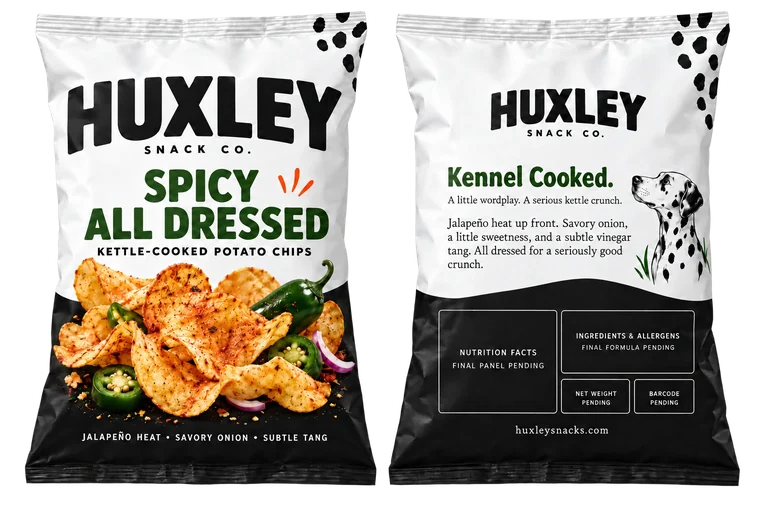
Clear from
the beginning.
Joey Cifalino is a founder with ownership interests in both ERN and Huxley.
That shared role creates a potential conflict. Joey may benefit from Huxley’s success, ERN’s fees and optional tips. Any financial benefit, fee and decision-making role must be disclosed before launch. ERN’s team reviews campaigns; at present, that team is Joey alone. Huxley would therefore be a related-party self-review, with no independent reviewer or independent approval. This disclosure does not mean Huxley has been approved to launch.
What a contribution would mean
The proposed model is a voluntary, one-time gift to a private business. It would not include a product, reward, service, equity, repayment or financial return. This demo is not a charitable fundraiser and does not offer a tax-deductible donation.
ERN’s proposed service and fee
The planned 5% contribution-route platform fee would cover campaign preparation, campaign materials and simple, free, permitted organic promotion toward startup funding for approved campaigns, within ERN’s limited capacity. ERN does not pay for company advertising. Founders remain responsible for their wider business marketing. Huxley is intended to launch alone; the next founder would be added after testing the process. No reach, fundraising or business-success outcome is guaranteed. Every campaign requires ERN review and approval before it can go live.
How promotion would be tailored
ERN’s first focus is helping student founders get started. Each campaign’s preparation and promotion would connect the company’s story with relevant-industry alumni from the founder’s college.
For Huxley, the proposed audiences include alumni in food, retail, restaurants and consumer brands, as well as the broader Providence College alumni and parent community. This is a strategy for review, not a claim of outreach, access, university permission or endorsement. Promotion would use simple, free, permitted organic channels; ERN would not pay for advertising.
Where money would go
The contribution route is planned as voluntary support without equity. A 5% ERN platform fee is proposed for contributions through ERN, not as an investment commission. Processing and payout charges, the legal recipient, provider, payout control and timing, and responsibility for losses are not confirmed. The demo illustrates amounts before unknown costs; no final founder payout is quoted. Optional tips default to $0. No escrow or custody protection is promised.
Proposed policies: changed plans & unused funds
Refund eligibility, fee and tip treatment, payout timing and control, and refund funding are under review before launch. A proposed 14-day founder-nonresponse threshold is an escalation deadline, not guaranteed recovery or a refund date. Material changes and unused funds need finalized consent and accounting rules; silence does not authorize repurposing. No real funds are accepted. Read the current funding and fee status.
Properly disclosed, authorized spending may be unrecoverable. Returning available unused funds proportionally is proposed for review, with full-refund obligations, authorized costs and disclosed fees accounted for. Contributors could receive a partial refund or none. Final closure, surplus and refund rules must be approved before contributions open.
Refund option under review
Refund eligibility, fee and tip treatment, payout timing and control, and refund funding are under review before launch. A proposed 14-day founder-nonresponse threshold is an escalation deadline, not guaranteed recovery or a refund date. Material changes and unused funds need finalized consent and accounting rules; silence does not authorize repurposing. No real funds are accepted. Read the current funding and fee status.
Campaign review and missed milestones
Before launch, ERN requires a written spending plan, evidence of costs and a 30/60/90-day plan. These materials have not yet been completed or approved for Huxley.
Refund eligibility, fee and tip treatment, payout timing and control, and refund funding are under review before launch. A proposed 14-day founder-nonresponse threshold is an escalation deadline, not guaranteed recovery or a refund date. Material changes and unused funds need finalized consent and accounting rules; silence does not authorize repurposing. No real funds are accepted. Read the current funding and fee status.
What ERN would verify
The tentative affiliation check starts with a verified school email, with additional current-enrollment evidence if needed. A student ID alone does not establish current enrollment. Alumni would provide a graduation record or another verifiable college record. Redaction of unnecessary information is allowed.
For this Huxley demo: legal recipient and college affiliation have not been verified through ERN; complete cost evidence has not been approved; a manufacturer is not confirmed; ERN campaign approval is pending. No proof documents are collected here. A future review would state exactly what was checked and would not guarantee success.
Campaign duration and goal changes
The selected model keeps a campaign open until its approved goal is reached, subject to applicable obligations; there is no fixed deadline. New contributions then pause unless and until ERN approves a revised goal. Huxley’s goal remains unset until its full budget is verified. A founder would identify the net amount required; the gross funding goal would cover the 5% ERN fee plus projected gift-processing costs based on the provider’s rates and contribution assumptions, then round up to the next $500. No goal can be calculated accurately without the provider’s rates and contribution assumptions. Any net rounding surplus after fees would be listed as a campaign contingency for stated costs such as shipping, additional testing or production overruns. It is not extra ERN revenue and remains subject to the unspent-funds policy.
A revised goal or stretch request would need a new 30/60/90-day plan and updated financial and cost evidence. ERN must approve the revision before a higher goal is displayed publicly. This does not authorize automatic overfunding or repurposing contributions.
Supporter identity and amount visibility
The proposed live choice would allow a public name or anonymity to the public and founder, while authorized ERN staff and the provider may still access identity as their systems require. A connected payee may also see provider records; display anonymity is not a guarantee of anonymity in payment records. Because Joey runs both ERN and Huxley, anonymity from Joey cannot be guaranteed. Supporters must choose identity visibility for each contribution, without an assumed default.
Individual contribution amounts would be hidden by default, with an optional public display choice. Aggregate campaign progress would be separate. This public preview collects no contribution identity or payment information.
What this demo collects
Guest contributions without an ERN account are the selected direction for a future live flow, subject to provider verification requirements. This preview has no checkout. It does not request names, email addresses, bank accounts or card details. No contribution is submitted, saved to a campaign ledger or added to a public total. The hosting service still handles normal page requests.
 Equity Resource Network